America
Australia
Scotland
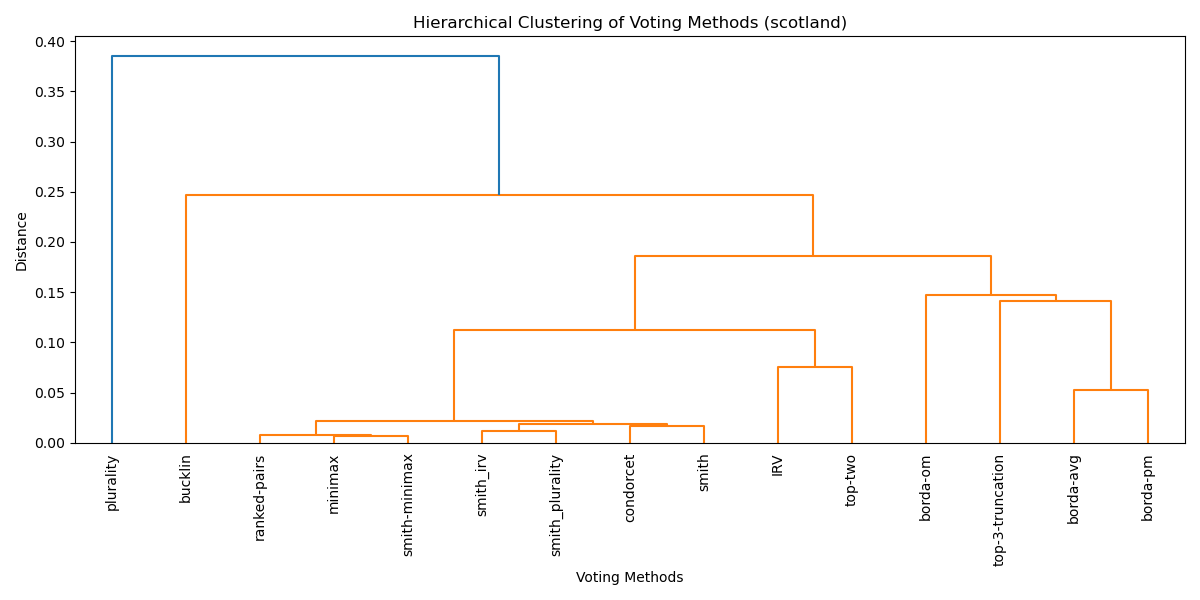
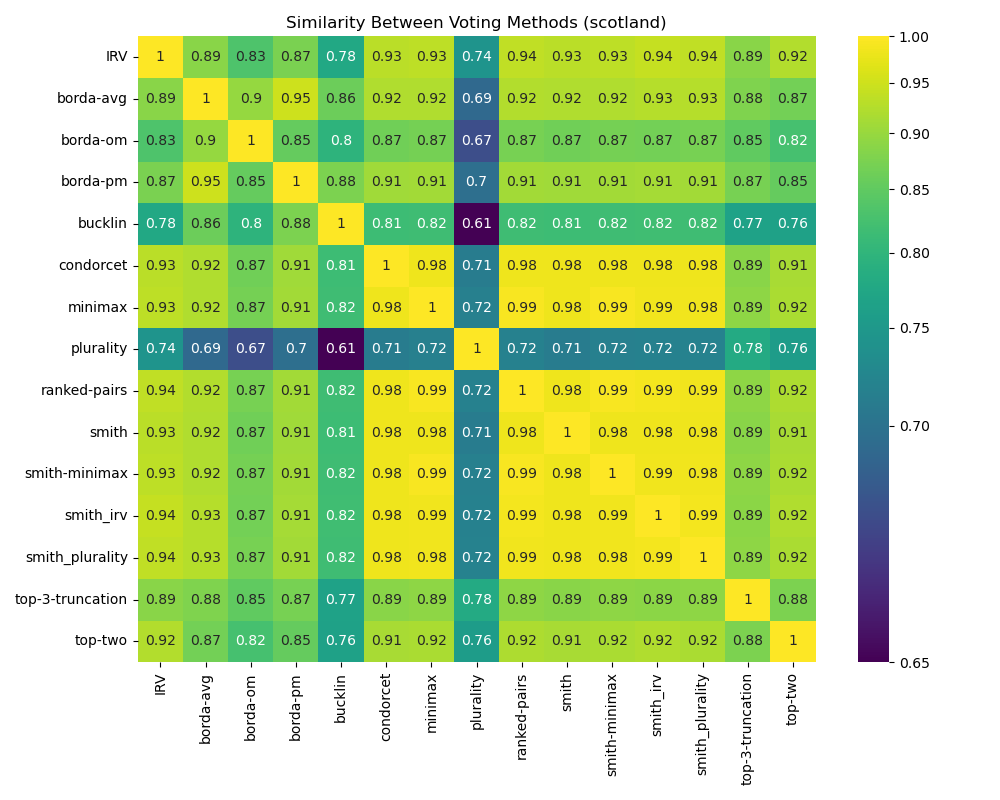
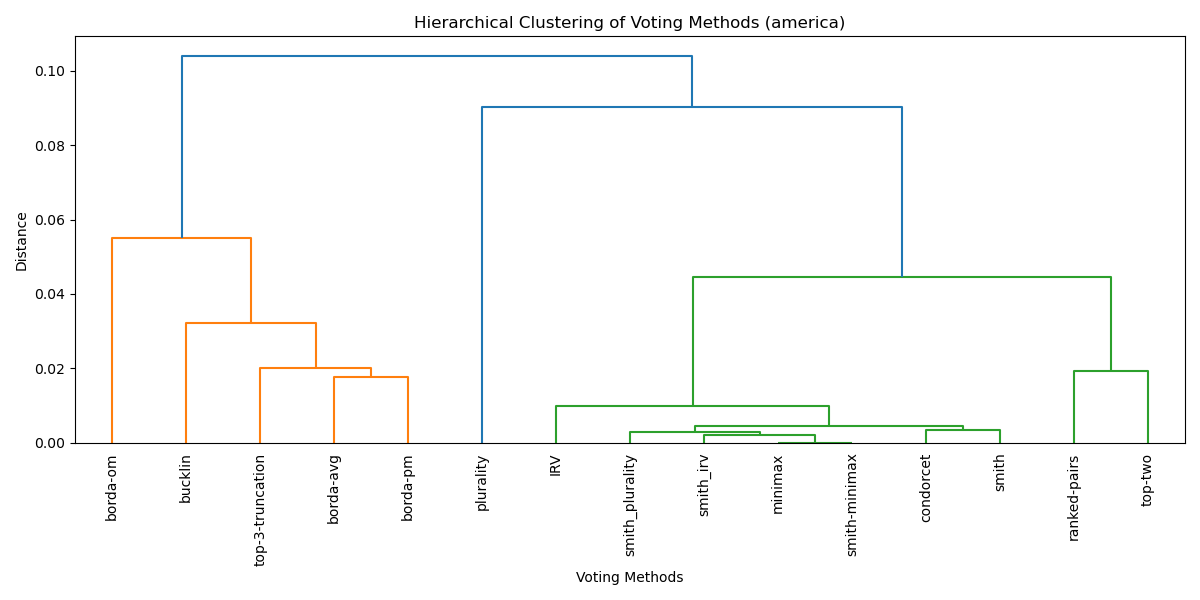
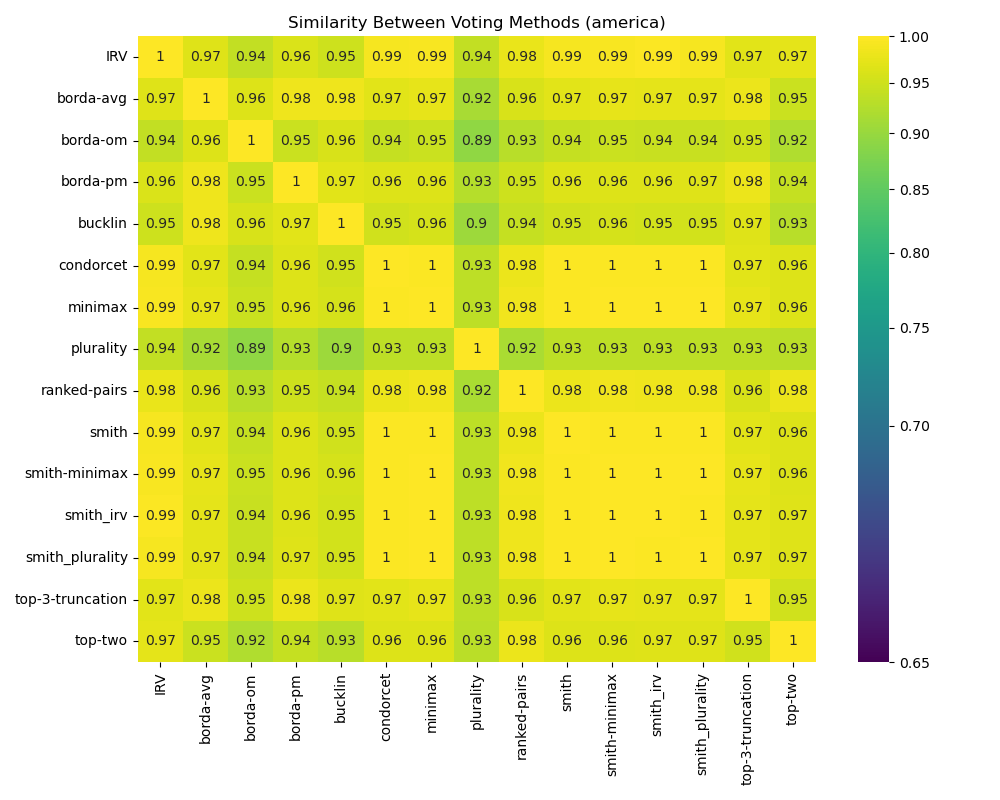
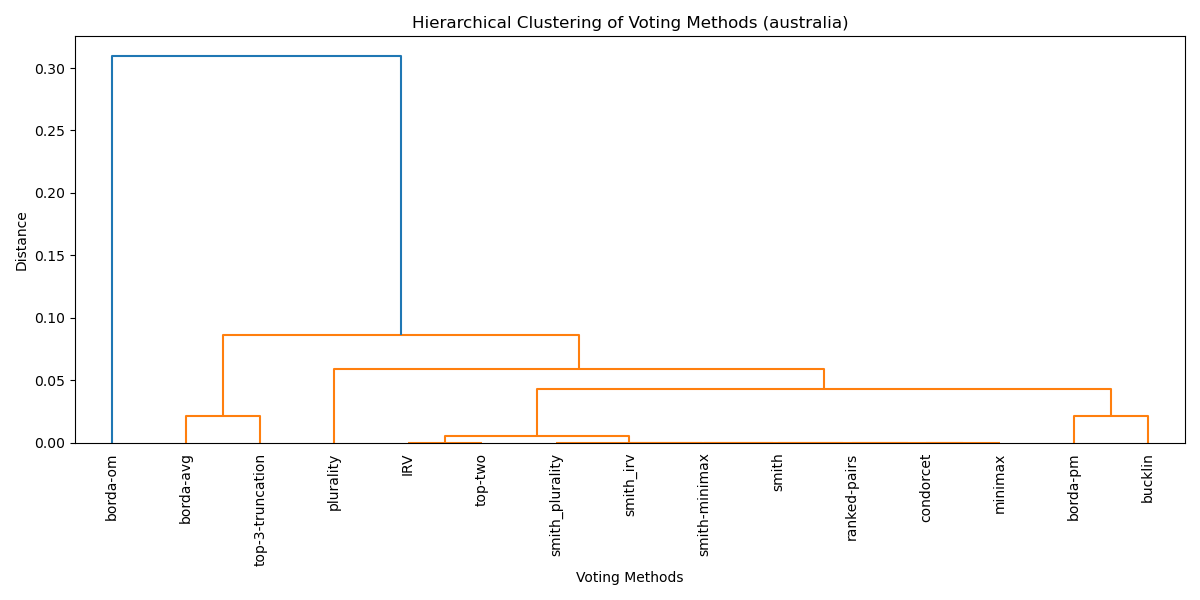
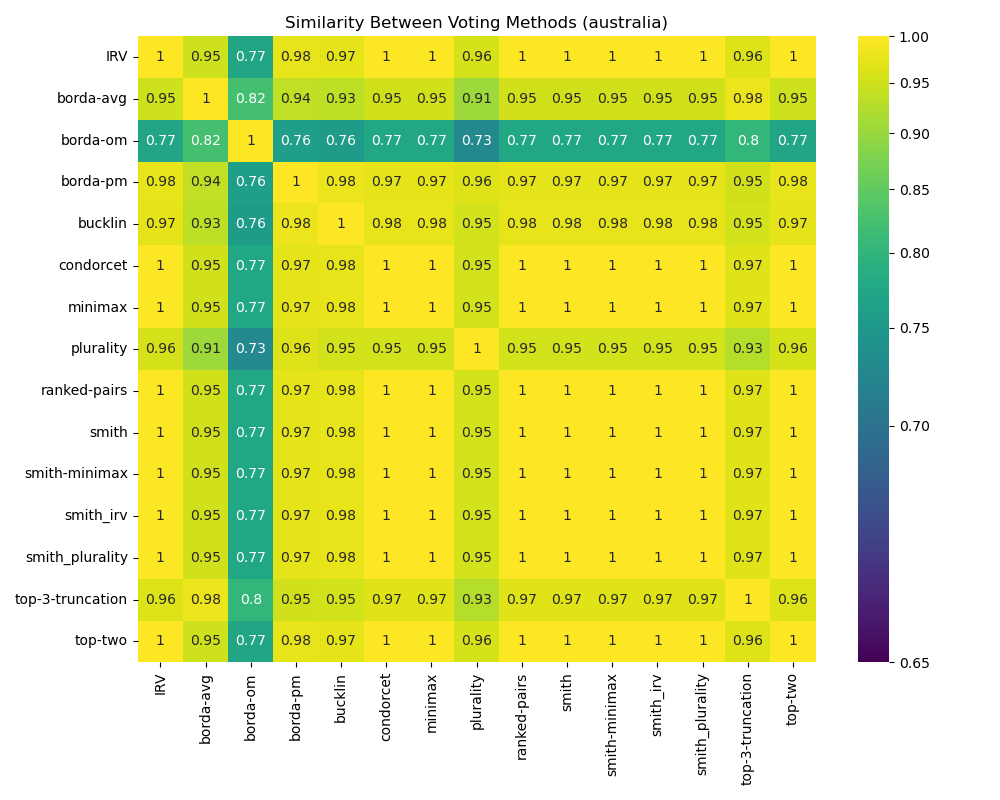
This page gives summary statistics for the results from our experiments looking at real-world data from America(n=567), Australia (n=327), and Scotland (n=1128).
We compare the various voting methods to determine how often the elect the same winner. This allows us to create a “similarity matrix” which we can then use to create heatmaps and dendrograms to visualize the “closeness” of the voting methodologies. Results are shown for each of American, Australia, and Scotland, as well as across all three countries.
One hopes that an election method will avoid electing “fringe” candidates. Unfortunately there isn't consensus on what makes a candidate fringe. In our case, we labeled a candidate “fringe” based on their (average) Borda score in comparison to the maximum (average) Borda score. We counted fringe winners for each of 9 ways of setting a “fringe threshold” and displayed those results in a graph.
American voters are used to the winner being the candidate with the number of first place votes, so it might be concerning for voters if the winning candidate is “too far” from being a winning candidate under plurality. These graphs show the number of elections where the winning candidate was not the plurality winner or plurality runner-up.
Top-k voting methods --- where one voting method is used to winnow down the candidate pool, and a second is used to select the winner --- have some appeal in voting reform circles. We determined the number of elections where the winner would change if you reduced the candidate pool to the top four plurality winners. Note that Scotland has a large number of such elections since their elections are actually multi-winner, and so a single party will often be represented by a number of candidates on the ballot (and, therefore, voters aligned with that party might have ballots that rank those candidates differently).
Majority winner: when a majority winner exists, the method does not elect the majority winner. Condorcet loser: the method elects a condorcet loser (candidate that is defeated in a head to head compairson with every other candidate). These graphs show the number of elections where a particular method was susceptible to these failures.
A “clone” candidate is one which aligns with a leading candidate in many ways; in plurality elections, a competing party might try to incentivize such a clone candidate to run in the hopes of ciphoning off support from the original candidate. We simulated the insertion of one clone candidate in elections, giving the clone candidate a probability (either 0%, 10%, 20%, 30%, 40%, or 50%) of appearing ahead of the original candidate on the ballot. We then checked to see whether the insertion of this clone candidate would spoil the election (i.e., change the result of the election). These graphs show the proportion of elections which were spoiled in this way.
A candidate is called a “spoiler” if they are a losing candidate, but their removal from the pool of candidates results in a different winner in the election. In these graphs we determined the number of elections in which at least one spoiler candidate existed.
Fringeness is decided by percentage of the first place Borda average score. I.e. a winner is considered fringe if it's Borda score is less than x percent of the first place Borda score.
Goal: Condense each Scottish election so that every party only has 1 representative
borda score – for each party, only keep the candidate with
the highest borda score
mention score – for each party, only keep the candidate
with the highest mention score
first place score – for each party, only keep the candidate
with the highest first place score
borda tiebreaker – for each ballot, use borda score as a
measure to determine which candidate to keep from each party
mention tiebreaker – for each ballot, use mention score as
a measure to determine which candidate to keep from each party
first place tiebreaker – for each ballot, use first place
score as a measure to determine which candidate to keep from each
party
keep first mentioned – for each ballot, only keep the first
candidate mentioned (from rank 1 to rank n) from each party
keep last mentioned – for each ballot, only keep the last
candidate mentioned (from rank 1 to rank n) from each party
Goal: Condense each Scottish election so that every party only has 1 representative
borda score – for each party, only keep the candidate with
the highest borda score
mention score – for each party, only keep the candidate
with the highest mention score
first place score – for each party, only keep the candidate
with the highest first place score
borda tiebreaker – for each ballot, use borda score as a
measure to determine which candidate to keep from each party
mention tiebreaker – for each ballot, use mention score as
a measure to determine which candidate to keep from each party
first place tiebreaker – for each ballot, use first place
score as a measure to determine which candidate to keep from each
party
keep first mentioned – for each ballot, only keep the first
candidate mentioned (from rank 1 to rank n) from each party
keep last mentioned – for each ballot, only keep the last
candidate mentioned (from rank 1 to rank n) from each party
Let W be the winning candidate and L be a losing candidate.
Let W be the winning candidate and L be a losing candidate.
Expected_values.csv
Prob_change_winner.csv
Expected_values.csv
Prob_change_winner.csv
Expected_values.csv
Prob_change_winner.csv
Expected_values.csv
Prob_change_winner.csv
Polling Strategies:
Expected_values.csv
Prob_change_winner.csv
Winner_poll_positions.csv
Expected_values.csv
Prob_change_winner.csv
Winner_poll_positions.csv
Expected_values.csv
Prob_change_winner.csv
Winner_poll_positions.csv
Expected_values.csv
Prob_change_winner.csv
Winner_poll_positions.csv
Let W be the winning candidate and L be a losing candidate.